

Staying connected while travelling with teenagers is often a debated topic—do you let them stay glued to their screens, or do you encourage them to “unplug”? When we planned our two-week adventure through Japan with our three teens (ages 14, 14, and 15), we realised that connectivity wasn’t just about them feeling connected to their friends, it was about us feeling like they were safe and able to connect to us.
During our 15-day journey, one of the smartest logistical moves we made was getting every member of the family a Sim Local eSIM from AU, one of the best local networks in Japan. While Matt and I had used eSIMs on previous trips, this was the first time we decided the girls needed them too. Here is why we highly recommend them for any family traveling with teens.
AD | We have been or could be if you click on a link in this post compensated via a cash payment, gift or something else of value for writing this post. As an Amazon Associate and Stay 22 we earn from qualifying purchases. See our full disclosure policy and privacy policy for more details.
In this article we will be reviewing Sim Local, an Irish company with more than 15 years in the market that sells eSIMs and SIM Cards for more than 220 destinations around the world. During our last trip to Japan we put them to the test. This is our honest review of our experience while traveling, its coverage, prices and more, which should be relevant when choosing a Japan eSIM.
Ready to stay connected? Get your Sim Local Japan eSIM here and use code MINITRAVELLERS for a 5% discount.
How easy was the set-up
The beauty of the eSIM is the lack of physical “faff.” An eSIM is a digital version of a physical SIM card that allows you to activate a mobile plan without the “faff” of swapping out tiny pieces of plastic, which takes you less than five minutes. We installed our eSIMs before arrival and simply activated them the moment we landed at Haneda Airport.
The process is quite simple, you choose the plan that best suits your needs, verify that it covers the entire duration of your trip, make the payment, use the code MINITRAVELLERS to get a discount. You receive a confirmation email along with a QR code that you must scan, follow a couple of easy steps and you are ready to travel. This meaning that from the very first hour—while navigating our transfer to Asakusa—we were already online and reachable.
For this trip, we chose unlimited Sim Local eSIMs from AU. AU, is renowned for its superior coverage and speeds across the country. Unlike some roaming plans that might throttle your data, these plans are designed for heavy usage, providing reliable high-speed data. It is a rare thing to say about travel tech, but I can honestly say we had consistent connectivity throughout the entire trip, whether we were in the heart of Tokyo or hiking the Nakasendo trail.
The plan we chose for our 15-day trip was the AU unlimited plan for $39, meaning we paid around $2.6/day even though we had an unlimited plan we think is a low value for the amount of data you have access to each day.
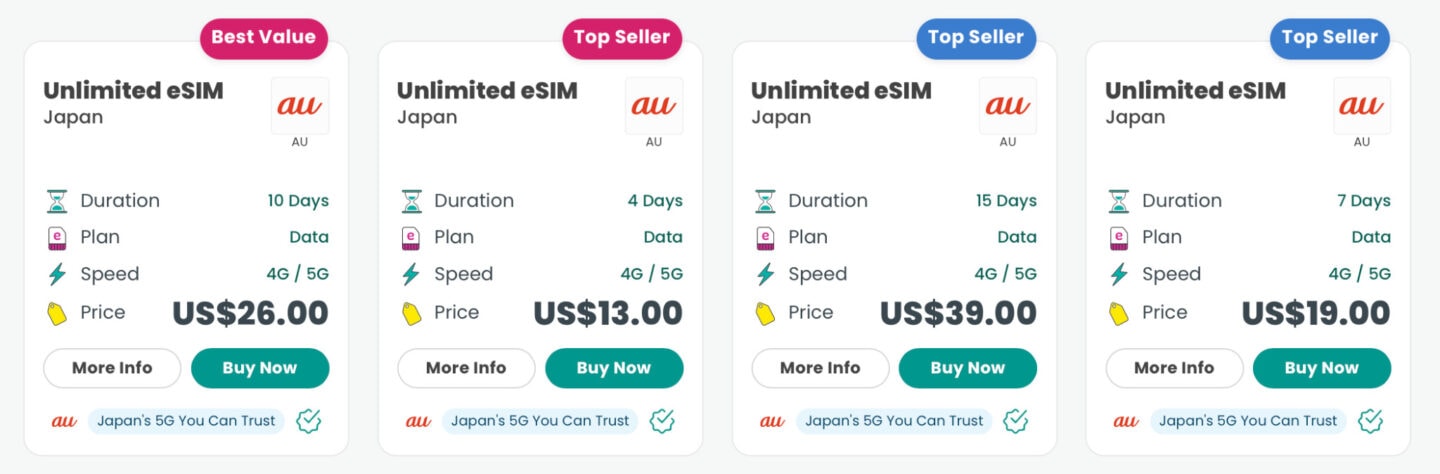
The reason of choosing a Japan unlimited eSIM
Many travellers underestimate the use of data during their travels. Here I share with you a basic guide:
- Light use: Google Maps, texting, navigation (between 5GB and 7GB per week)
- Moderate use: social media browsing, uploading content (between 10GB and 15GB per week)
- Heavy use: video streaming – as teenagers can do on Instagram or TikTok -, remote work (more than 20GB)
In case you’re not quite sure which plan to choose, Sim Local has a great and simple tool called Find My Plan, which through 4 simple questions helps you choose the plan that best suits your needs so you pay for what you really use, and taking into account that we all needed to have connection all day, teenagers tend to use their phone the most and trusting the best provider, we chose AU’s unlimited eSIMs, this to give us total peace of mind while we traveled the busy streets of Tokyo or traveled the different subway lines.
Why it’s useful to have a Japan eSIM
Japan is many things, but “quiet” is rarely one of them. Places like Takeshita Street in Harajuku or the Shibuya Crossing are mentally busy, with crowds that can easily swallow up a distracted teenager.
Our primary motivation for getting the girls their own data plans was simple. We wanted to know that if we got separated in the sea of people, they had the immediate ability to call or message us. This was particularly useful on the Japanese transport system. While the trains are excellent, they are also complex; knowing that everyone could “find each other” via GPS or messaging allowed the entire family to feel more relaxed on public transport.
But having individual data plans for every family member wasn’t just a luxury; it was central to how we navigated the whole trip which you can see from these scenarios:
- Safety in “Mentally Busy” Crowds: In the “sea of people” at Shibuya Crossing and the packed Takeshita Street in Harajuku, we wanted the peace of mind that if we were separated, the girls could immediately message or call us.
- Independent Exploration: Having data gave our teens the freedom to wander a different aisle of MEGA Don Quijote or browse fashion boutiques in Harajuku without being tethered to our side every second.
- Navigating the Transport System: The Japanese train system is “excellent but complex”. We used Google Maps constantly to find our way, including locating specific landmarks like the Giant 3D Cat in Shinjuku or checking the Sagano Romantic Train and Romance Train routes.
- Real-Time Problem Solving: Connectivity allowed us to cross-reference information on the fly, such as checking the correct opening times for Otagi Nenbutsu-ji when Google Maps was slightly off.
- Rural Reliability: We experienced consistent connectivity even outside the major cities, whether we were hiking the Nakasendo trail, exploring Arashiyama bamboo forest, or heading to Miyajima island.
- Managing Bookings: We also relied on the eSIM to access the Klook app to manage tickets for Shibuya Sky and airport transfers when direct websites were difficult to use.
Are you ready to stay connected in Japan? Use our promo code MINITRAVELLERS and save money on your eSIM
Transparency: Is the service perfect?
While our experience was remarkably seamless—even during sumo shows or admiring the blossom at Hamarikyu Gardens—no service is 100% perfect. In very deep underground train stations or extremely remote areas, signal strength can occasionally dip. However, compared to relying on spotty public Wi-Fi, or compared to UK coverage on trains, the AU plan via Sim Local was very very reliable.
In case you have any problems with your eSIM, which fortunately did not happen to us, Sim Local, unlike other eSIM providers, has a real-people customer support team available at all times, arranged at different points of contact, calls, WhatsApp or email that usually responds within minutes and are genuinely interested in helping you.
In addition, they have a 100% no-questions-asked refund policy, if your eSIM is not working properly or you no longer need it, you can request a refund of your money without asking questions, all within 14 days of purchasing your eSIM.
Comparison of top Japan eSIM plans
| Feature | Sim Local (AU Plan) | Standard UK Roaming |
| Data Limit | Unlimited (High speed daily) | Often capped at 500MB/day |
| Tethering | Supported (Hotspot for laptops) | Frequently restricted |
| Network | Direct Local (AU) | Third-party roaming |
| Setup | Digital/Instant | Physical SIM swap |
Who is a Japan eSIM best for?
- Families: Essential for safety and preventing “getting lost” stress in busy areas.
- Solo Travellers & Digital Nomads: High-speed data and tethering make it ideal for working or planning on the go. Also if you plan to stay longer in the country.
- Groups: Allows everyone to split up and meet back at spots without needing to stay in sight of each other.
Frequently Asked Questions about eSIM Japan
Can I use my eSIM for calls and texts?
Most Japan eSIMs are data-only, but you can use apps like WhatsApp, FaceTime, or Messenger to stay in touch using your data plan.
Will it work in smaller cities?
Yes. By using a local provider like AU, you get coverage in smaller cities and rural areas like the Nakasendo trail and Miyajima Island, not just Tokyo. For more details on regional travel, you can check the Official Japan Guide.
How do I know if my phone is compatible with an eSIM?
Most of the newer phones are, if you have from the iPhone XR or more advanced, Samsung Galaxy S20 or newer, Google Pixel 3 or newer, you will be fine. You can also check the Sim Local page to confirm that your phone is compatible with the technology.
Can I have my home SIM Card active while traveling?
Yes, you can have your SIM Card active while you are traveling, here the recommendation is to turn off data roaming before traveling to avoid any huge roaming fee surprise from your home provider.
Final Recommendation
My recommendation is if you’re heading to Japan, don’t rely on finding public Wi-Fi and want to have a reliable 4G/5G connection from the moment you touch down, it’s much easier to have the connectivity ready to go, which is why we used a Sim Local eSIM in our last trip, if you use the discount code MINITRAVELLERS, you can even get a 5% discount.
Equipping your teens with eSIMs is a small price to pay for the security and freedom it provides, ensuring your family adventure is remembered for the incredible sights.
Overall, Sim Local offers everything you need in a phone plan when you are traveling, reliable and fast 4G/5G connection, local providers, 24/7 customer service available and willing to help, and most important, the most-affordable prices. Don’t waste your money and trust a company that knows what it’s doing.
